From Roadmap To Governed AI

AI Strategy and Governance Services At Enterprise Scale

SDLC Corp's AI strategy and governance services help enterprises decide where AI creates business value, set the policies, risk tiers and human oversight that keep it safe and compliant, and scale it across the business. One team covers the roadmap, the controls and the build, so strategy does not stall before delivery.

  • 300+AI Deployments
  • 400+AI Specialists
  • 40+AI Products Shipped
  • 10+Industries Served
Security & qualitySOC 2 Type IIISO 27001ISO 9001Visit the Trust Center
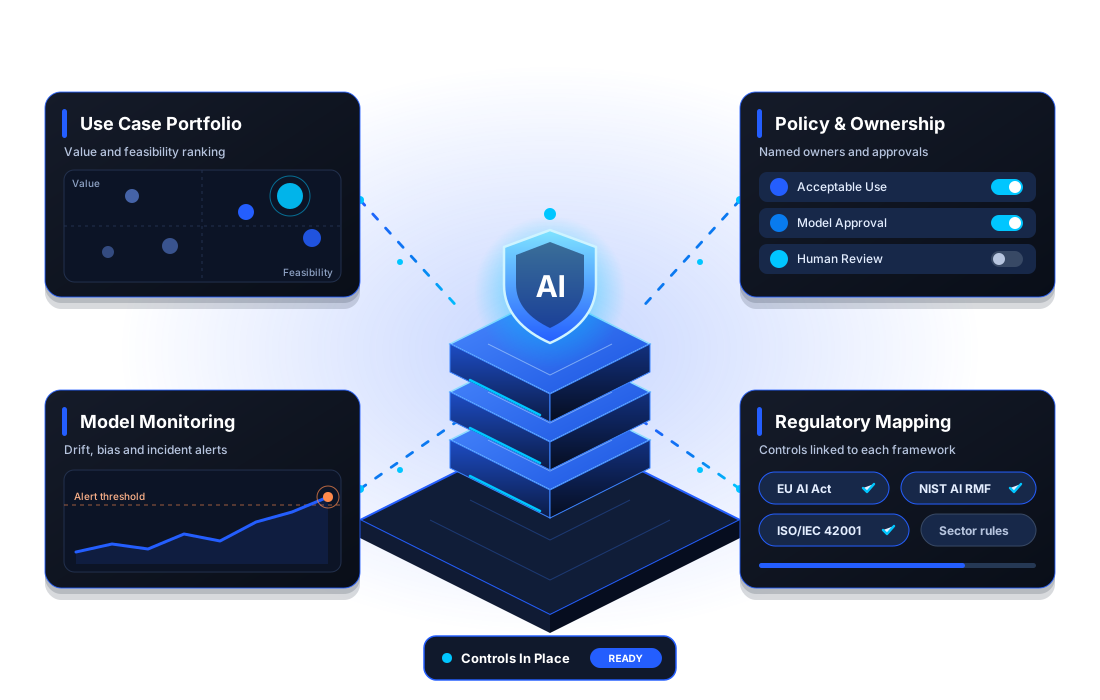
AI strategy and governance services diagram: a strategy layer picks the use cases, a governance shield sets controls and policy ownership, and monitoring and regulatory mapping keep AI compliant before it is delivered at scale.

Trusted by Fortune Global 500 leaders, governments & top universities across 30+ countries

Powered by leading cloud & AI platforms

Recognized by leading industry reviewers

Awards & industry recognition

Deliverables

What Our AI Strategy and Governance Services Deliver

Concrete outputs, not slideware. Pick a layer to see what our AI strategy and governance services produce and what they leave you with.

Strategy layer

Where should we apply AI?

OutcomeA prioritised, funded roadmap your leadership can approve.

What you receive

  • AI readiness assessment and maturity scoring
  • Ranked use case portfolio with value and risk scores
  • Target architecture and build-versus-buy guidance
  • Phased roadmap and business case
  • Delivery and investment plan
Governance layer

How do we keep AI safe and accountable?

OutcomeControls your teams, customers and auditors can follow.
Risk tier modelControls scale with impact

Four tiers, from low risk to restricted, decide how much oversight each system needs.

See the four risk tiers

What you receive

  • AI system inventory and risk-tier model
  • Policy set, acceptable-use and review rules
  • Accountability and human-oversight design
  • Evaluation, monitoring and incident-review process
  • Mapping to frameworks relevant to your markets
Transformation layer

How do we make this work at scale?

OutcomePriority use cases moving into governed production.

What you receive

  • Enterprise AI reference architecture
  • Integration plan for ERP, CRM, APIs and data platforms
  • Data and AI modernisation roadmap
  • Operating model, roles and delivery cadence
  • Priority use cases moved into build

Not sure where to start? Find the right service

Maturity

Where Is Your Organisation On The AI Maturity Curve?

These five AI maturity model stages are illustrative. Your assessment result then tells us which layer to prioritise first.

  1. Stage 1

    Explore

    Awareness and first experiments. No shared direction yet.

    Focus on Strategy
  2. Stage 2

    Experiment

    Several pilots running. Value and risk not yet measured.

    Focus on Strategy
  3. Stage 3

    Operationalise

    First systems in production, with only basic controls.

    Focus on Governance
  4. Stage 4

    Scale

    Shared platform, governance and cadence across teams.

    Focus on Transformation
  5. Stage 5

    Optimise

    AI embedded in strategy, constantly measured and improved.

    Focus on Strategy
Not sure where you sit?

Find your stage and which layer to tackle first.

Book an AI readiness assessment
Governance And Security

Eight AI Governance Questions Every Programme Must Answer

A working AI governance framework answers these questions before launch, not after. It is designed into delivery, not reviewed at the end.

  • Who owns each AI system and its outcomes?

  • Which use cases are low, medium or high risk?

  • How is data sourced, protected and retained?

  • Can decisions be explained to users and auditors?

  • Where must a person review or override output?

  • How are drift, bias and failures detected after launch?

  • What is permitted with third-party and generative AI tools?

  • Who signs off before a system reaches customers?

Frameworks and requirements that may apply, depending on organisation, jurisdiction, data and use case:

Guidance only, not legal advice.

Risk Tiering

An AI Governance Framework That Matches Controls To Risk

An illustrative risk-tier model for your AI governance framework. Not every system needs the same scrutiny, and heavier controls belong where the impact is highest.

Tier 1Low

Typical use

Internal drafting aids, search over public content

Controls

  • Usage policy
  • Basic logging
Tier 2Medium

Typical use

Customer-facing assistants, internal decision support

Controls

  • Human review sampling
  • Evaluation before launch
  • Monitoring
Tier 3High

Typical use

Decisions affecting people, money, health or safety

Controls

  • Mandatory human oversight
  • Audit trail
  • Formal approval
  • Periodic re-assessment
Tier 4Restricted

Typical use

Uses your policy or regulation prohibits

Controls

  • Not permitted
  • Documented exception path only

Your final tiers should follow the regulations and policies of your industry and markets.

After The Strategy

Continue Into The Capability Families

Once your AI strategy and governance controls are set, specialist teams take priority use cases into build.

Generative & Agentic AI

LLMs, RAG, agents and chatbots grounded in your knowledge.

Machine Learning & Intelligent Systems

Predictive, language, vision and decision systems.

Data & AI Operations

Data foundations and the operations that keep AI reliable.

AI Development & Engineering

Production AI applications built around your workflows.

Client Stories

What Clients Say About SDLC Corp

Founders and operating leaders on what it is like to build with our teams.

5.0 ★★★★★ Clutch Rating
Client story

Eric Leist

CEO, Edgerton Strategies

Client story

Doug Schmidt

CEO, Roofaid USA

Client story

Reyzal Razmi

All Star Influencers

What clients say
01 / 03 Verified on Clutch
They've quickly understood our business context, moved fast, and brought recommendations rather than questions.
Brandy Kuentzel
Co-Founder & CEO, Ease Pet Vet
Clutch review, Jul 2026

Ready to build your own success story?

Talk to our AI strategy team about your use cases, data and risk profile. We will scope the roadmap, the governance controls and the rollout with you.

Request a Free Consultation
5.0Clutch Rating
17Clutch Reviews
3,400+Completed Projects
2,000+Documents Per Day
120+Enterprise AI Integrations
48 hrs to 4 hrsProcessing Time
30%Less In-Game Cheating
FAQ

Common Questions About AI Strategy And Governance

Straight answers on planning, governing and scaling enterprise AI.

Ask us something else

What Is The Difference Between AI Strategy And AI Governance?

AI strategy decides where and how your organisation applies AI to create business value. AI governance, in contrast, defines the policies, controls and oversight that keep AI safe, compliant and accountable. Because each depends on the other, we design them together.

What Does An AI Governance Framework Include?

An AI governance framework typically includes an inventory of AI systems, a risk-tier model, policies and acceptable-use rules, accountability and human-oversight design, evaluation and monitoring, and an incident-review process. Together, these parts show who owns each system and which controls apply.

Who Should Own AI Governance In An Organisation?

Ownership usually sits with a cross-functional group under executive sponsorship, combining business, data, security, privacy, legal and risk. However, individual use-case owners stay accountable for outcomes. For this reason, the group sets policy while each owner runs controls day to day.

What Are The Stages Of An AI Maturity Model?

Most AI maturity models have five stages: Explore, Experiment, Operationalise, Scale and Optimise. Early stages call for strategy, the middle stage adds governance, and later stages depend on transformation. Therefore, finding your stage on the maturity curve shows which layer to tackle next.

What Is Enterprise AI Transformation?

Enterprise AI transformation is the organisation-wide change required to run AI at scale. It updates the operating model, data foundation, architecture, skills and processes, so AI moves from pilots into everyday operations.

How Do We Know If Our Organisation Is Ready For AI?

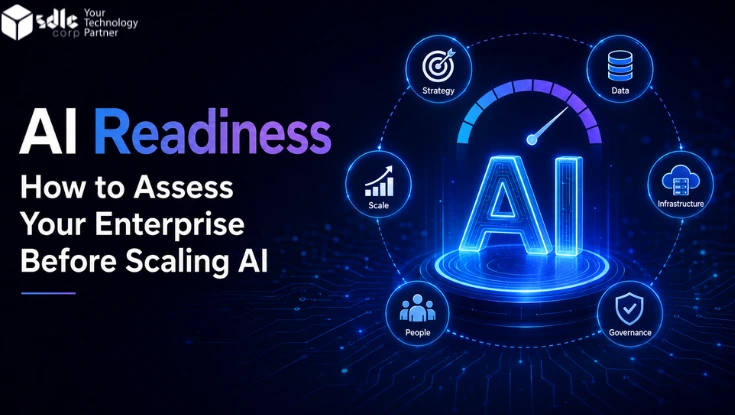
An AI readiness assessment reviews data quality and access, infrastructure, talent, leadership alignment, use case clarity and risk posture. As a result, it shows what to fix before investing in large-scale delivery.

Do We Need AI Governance If We Only Use Third-Party Or Generative AI Tools?

Yes. External tools still create risks around data exposure, output accuracy, intellectual property and compliance. For that reason, governance defines acceptable use, review requirements and accountability, whether you build or buy.

Which AI Regulations And Frameworks Should We Consider?

It depends on your industry and markets. Common examples include the EU AI Act, the NIST AI Risk Management Framework and ISO/IEC 42001, along with sector rules such as HIPAA and PCI DSS. We help you identify which apply, but this is guidance, not legal advice.

Can SDLC Corp Build The AI Solutions After The Strategy Phase?

Yes. SDLC Corp delivers AI development, generative AI, machine learning, MLOps and data engineering. As a result, strategy and delivery stay connected.

Where Should We Start?

Most clients begin with an AI readiness and use case prioritisation engagement. In parallel, they set up governance, so controls are in place before scaling.

Is AI Strategy The Same As AI Consulting?

AI consulting is the engagement: readiness, use case discovery, architecture and roadmap. AI strategy and governance, however, is the wider programme that also covers governance and transformation. Choose AI consulting if you want a consulting partner, and use this page to see how the three layers fit together.

Next Step

Build An AI Programme That Is Strategic, Governed And Ready To Scale

Speak with our AI specialists about AI strategy and governance services, from readiness assessment to a governed rollout.

Let's Talk About Your Project

Get expert guidance on architecture, scope, timelines, and delivery approach so you can move forward with confidence.

What happens next?