A utility phone line carries two flows that behave nothing alike. One is steady and predictable: readings, bills, moves, tariff questions. The other arrives without warning when something fails, and for a few hours it can be larger than everything else the line handles in a month.
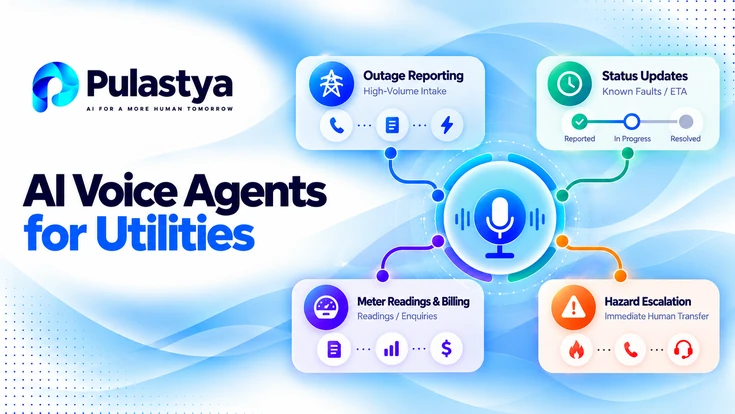
- One answer, many callers An outage produces a flood of calls that mostly want the same thing, which is exactly the shape automation handles well.
- Hazards leave immediately A gas smell or a fallen line is not a field to capture. It is an exit from the automated path to a person, with the threshold set low.
- Readings need reading back Digits spoken from a meter cupboard with poor signal are worth confirming before they are recorded, or offering on the keypad instead.
Designing for the steady flow alone produces a system that works right up until the day it is most needed. Designing for the spike alone produces something that mishandles the ordinary calls that make up most of the year.
The spike also has a shape worth understanding. It is enormous, but it is not varied. Most of it is the same question asked by different people at the same moment, and buried inside it is a much smaller set of calls that are about safety rather than inconvenience.
Two Directions of Traffic on a Utility Line
It helps to sort the line by how its traffic behaves over time rather than by which department owns it. Steady traffic can be planned for with staffing. Spike traffic cannot, which is why it is the part worth automating first even though it is the harder part to get right.
| Flow | What callers want | What the line has to do |
|---|---|---|
| Steady: meters and billing | A reading taken, a charge explained, a move recorded | Accuracy and a clean record |
| Steady: service questions | Process and tariff information | Consistent answers from approved content |
| Spike: outage status | To know it is known, and when supply returns | The same answer at volume, without a queue |
| Spike: hazard report | Somebody to attend now | Immediate recognition and a person |
The bottom two rows arrive together, through the same number, in the same minute. Separating them is the central problem of a utility deployment, and everything else is comparatively routine.
Getting an engineer to the right address afterwards is a separate problem with its own constraints, set out in voice automation for field service work.
The Outage Spike: Many Calls, One Answer
When supply fails, a line receives far more calls than it was ever staffed for, and the overwhelming majority of them are the same call. Is it known, and when will it be back.
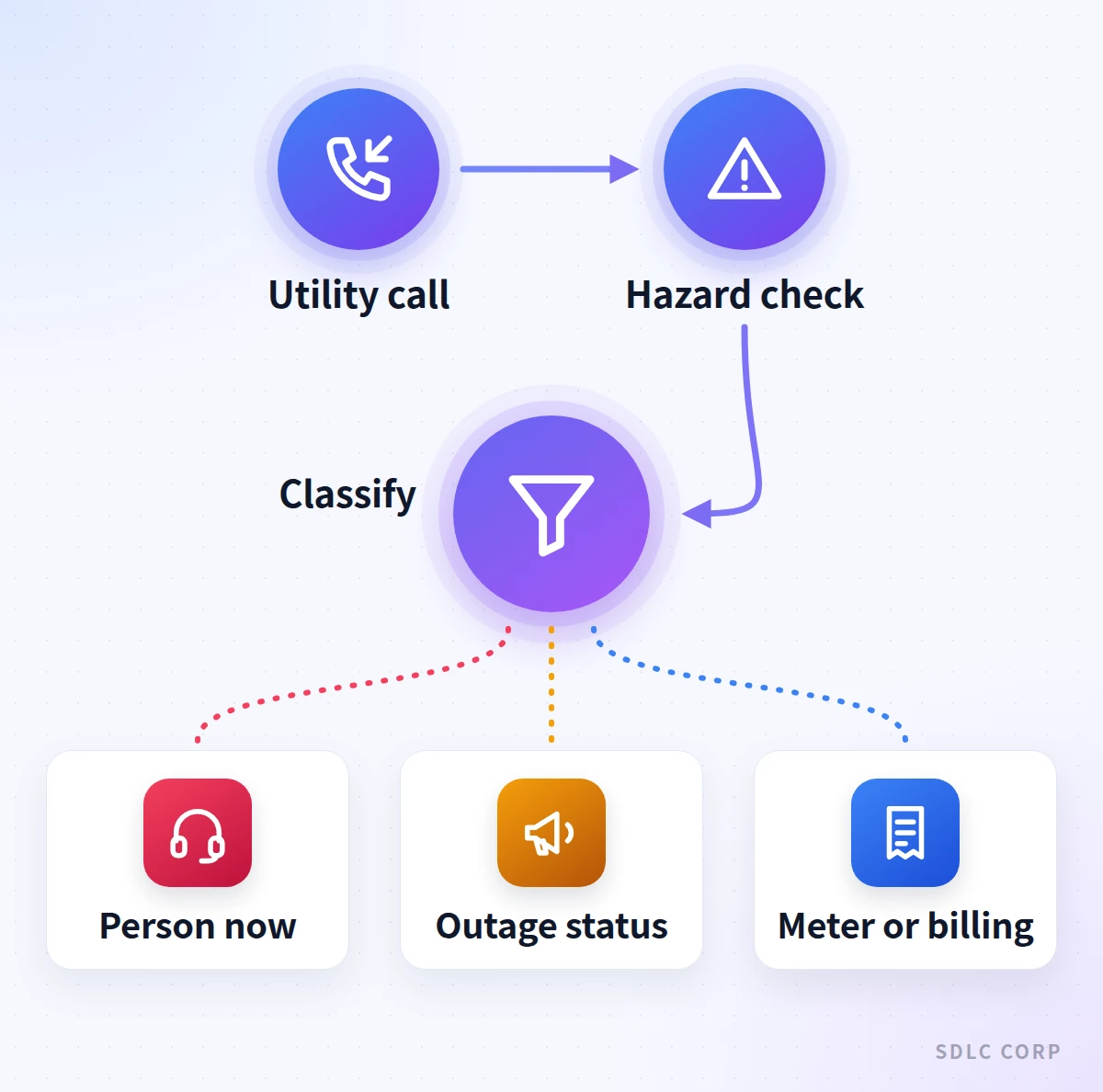
That uniformity is the opportunity. An answer trivial to give once is valuable precisely because it now has to be given continuously, to everyone, without a wait, while the people who normally staff the line do something more useful.
- Confirm the fault is known, when it is, in the first sentence rather than after a set of intake questions.
- State restoration information in the words the operations team approved, and nothing beyond them.
- Take a report when the fault is not already on record, with the location detail an engineer will actually need.
- Offer a callback or a notification when there is nothing useful to say yet, so the caller has no reason to ring again in ten minutes.
Two failure modes matter more than the rest. Promising a restoration time the operations team has not published turns one outage into a second wave of angry calls. Repeating a stale status after the fault record has moved on does the same thing more slowly.
Keeping that answer current is a content problem rather than a conversation problem. An agent whose answers are grounded in documents the organization provides, as Pulastya's are, is only ever as current as the status its operations team publishes into them.
The general pattern for answering a caller from a record is set out in answering status and progress enquiries.
Separating a Hazard Report From a Status Question
Inside the spike sits a small number of calls that are not about inconvenience. A gas smell, a fallen line, water where it should not be, a burning smell from a meter. These arrive in the same queue as everyone asking when the power comes back.
The agent's job is separation, not assessment. Anything that sounds like a hazard leaves the automated path at once and reaches a person, and the threshold is set low enough that ordinary status calls will sometimes cross it.
- Treat a hazard mention as an exit, not as a field to capture and then continue from.
- Do not ask the caller to confirm or describe the hazard further before connecting them.
- Accept the false positives. A status caller sent to a person is a minor cost; a hazard call held inside automation has no acceptable size.
- Never end a hazard call on the agent. If a transfer cannot connect, the standing safety instruction is spoken instead.
This is the one call type where being wrong in the cautious direction costs almost nothing. Set the trigger with the safety owner rather than with the team measuring containment, and review it after every event.
The standing safety instruction is written by the utility and names the number its own procedures use. It belongs in approved content with an owner and a review date, because it is the line that has to be right when everything else is busy.
Meter Readings and Billing Enquiries
The steady flow is where a voice agent does unglamorous and reliable work: taking a reading, explaining a charge, recording a move, and telling a caller what a line on a bill refers to.
A meter reading is a string of digits spoken by somebody standing in a cupboard with poor signal, and recording it wrong is worse than not taking it at all, because a bad reading produces a bill that generates its own complaint call later.
- Read back every reading and reference number before it is accepted into a record.
- Offer keypad entry as an alternative, since digits survive background noise and unfamiliar accents better than speech does.
- Capture the meter identifier when a property has more than one, rather than assuming which meter the caller means.
- Explain what a charge covers from approved content, without recalculating a bill during the call.
Which input suits which value is covered in keypad input alongside speech, and the readback and validation pattern in turning spoken requests into structured data.
Money owed is a different conversation with different constraints on what may be said before the utility knows who answered, described in calls about money owed.
Outbound: Telling People Before They Ring
The cheapest outage call is the one a customer never needs to make. Outbound notification moves the same information in the opposite direction, to the people a fault record says are affected.
It changes the shape of the inbound spike as well as its size. The callers who still ring after a notification tend to have something specific to say: a medical dependency on supply, a property that has been missed, or a hazard.
- Planned interruptions, with notice ahead of the work and the published window.
- Fault updates, sent when the operations record changes rather than on a fixed timer.
- Restoration confirmation, along with what to do if supply has not actually returned.
- Follow-up to the customer who reported the fault first, closing the loop they opened.
Pulastya handles inbound and outbound business calls on one platform, which matters here mainly because the status a caller hears and the status a notification carries should not end up as two separately maintained answers.
Calling hours, consent and suppression rules apply to all of this and vary by jurisdiction and by the purpose of the call, so establish what applies with counsel before a campaign runs. The general shape is set out in compliance rules for outbound calling.
What the Spike Does to Everything Behind the Agent
A surge is a capacity event before it is a conversation event. The agent may hold up perfectly while something behind it does not: a status lookup, a telephony leg, a model provider, or the staffed queue that escalations land in.
- Decide what the agent says when the status source is unavailable, and make it honest rather than vague.
- Decide where escalations go when the staffed queue is already full, and what the caller hears in the meantime.
- Keep the hazard path independent of anything that can be shed under load.
- Agree in advance what gets turned off first, so that the decision is not being made during the event.
The last point is the one most often skipped. A degradation plan written calmly in advance is a different artifact from a decision taken at two in the morning by whoever happened to be reachable.
Failure behavior deserves designing as its own subject, and what happens when a voice agent cannot continue sets out the options.
Scoping a Utility Deployment
Start with the steady flow, because that is where content and integrations get proven against calls you can check afterwards. Add the spike once the hazard path has been tested under conditions resembling a real event.
- Begin with meters and billing questionsRepetitive calls with stable answers and an obvious record of whether the agent got each one right.
- Write the hazard triggers firstAgree the wording and the exit behavior with the safety owner before any other content is loaded.
- Connect status to the fault recordDecide who publishes outage status into the agent's content, and how quickly a change reaches callers.
- Rehearse a surgeTest behavior when the status source is slow, the staffed queue is full and volume is many times its normal level.
- Place the calls yourselfUse your own content and your own hazard phrasings before launch, rather than a scripted demonstration.
Measure the spike separately from ordinary days. An average that blends a quiet Tuesday with an outage evening hides the only performance anyone will remember.
Utilities evaluate the same platform capabilities as every other sector and hold them against a different cost of failure, which the wider map of voice AI use cases by industry sets out sector by sector.
Conclusion
AI voice agents can help utilities manage high volumes of outage calls while answering routine questions about meter readings, billing and service status. Their usefulness depends on accurate, current information and reliable connections to the utility's operational systems.
Safety must remain a separate, carefully tested path. Hazard reports need utility-approved emergency guidance and rapid human escalation, including a clear fallback when a transfer cannot connect. Start with measurable routine use cases, rehearse outage surges and review call outcomes before expanding automation.
Frequently Asked Questions
That is the strongest case for one on a utility line. An outage produces far more calls than the line is staffed for, and most of them want the same two facts: whether the fault is known, and when supply returns. Answering that continuously without a queue is straightforward work, provided the status the agent reads is kept current by the operations team.
By leaving the automated path immediately. A hazard mention is an exit rather than a field to capture, and the agent should connect the caller to a person without asking them to confirm or describe it further. Set the trigger low enough that ordinary status calls occasionally cross it, and speak the standing safety instruction if a transfer cannot connect.
Yes, with care. Readings are digits spoken from awkward places with poor signal, so the agent should read every one back before accepting it and offer keypad entry as an alternative. Where a property has more than one meter, capture which meter the reading belongs to rather than assuming. A wrong reading produces a wrong bill and another call.
It reduces inbound volume and changes who still rings, leaving more of the specific cases that need a person. Planned interruptions, status changes and restoration confirmations all suit it. Calling hours, consent and suppression duties vary by jurisdiction and call purpose, so establish what applies with counsel before any campaign runs.
Usually something behind the agent rather than the agent itself: a status lookup, a telephony leg, a model provider, or the staffed queue escalations land in. Decide in advance what the agent says when a source is unavailable, where escalations go when the queue is full, and which parts get shed first so the hazard path stays untouched.