A public service phone line is not a customer service line with different branding. The person calling it usually has no alternative provider, often no alternative channel, and sometimes a deadline attached to whatever they are ringing about. That changes what counts as an acceptable failure.
- No alternative supplier Accessibility and a reliable route to a person are conditions of the service being available at all, not features to add after launch.
- Rules, not decisions An agent may state published eligibility criteria. Applying them to a caller's circumstances is a determination and belongs to an assessor.
- Recognize, never triage When an emergency reaches a non-emergency line, the agent's only job is to spot it immediately and get the caller to help.
A retailer that mishandles a call loses a sale. A public body that mishandles one can leave somebody without a service they are entitled to, and that caller has nowhere else to take the problem. The same automation decisions get made against a different downside.
Most of what follows is ordinary voice agent design held to a higher standard. Two things are genuinely specific to this sector: what may be said about eligibility, and what happens when a call to a general enquiry line turns out to be an emergency.
The Caller Who Cannot Choose Another Supplier
Commercial call automation is measured against abandoned calls and lost revenue. A public line is measured against access. If someone cannot get through, or gets through and is told something wrong, the consequence lands on them rather than on the organization's quarterly numbers.
Three obligations follow from that, and they are worth stating before any discussion of which calls to automate, because they constrain the answer rather than decorate it.
- Getting through has to work for everyone, not only for callers who speak clearly, hear well and own a smartphone.
- A route to a person cannot be a hidden fallback. It has to be reachable by somebody who does not know the right phrase to say.
- The agent has to be certain about what it does not know, because a wrong answer about eligibility can stop someone applying at all.
None of that rules out automation. It rules out the version of automation whose success is measured only by how many calls never reached a human being.
High-Volume Service and Status Enquiries
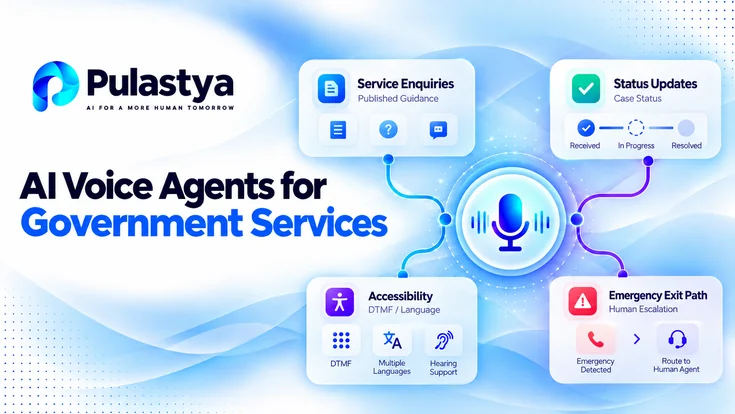
The bulk of a public line is repetitive and genuinely answerable: when a collection happens, what a form needs, where to hand something in, what a reference number means, and what stage a submitted request has reached.
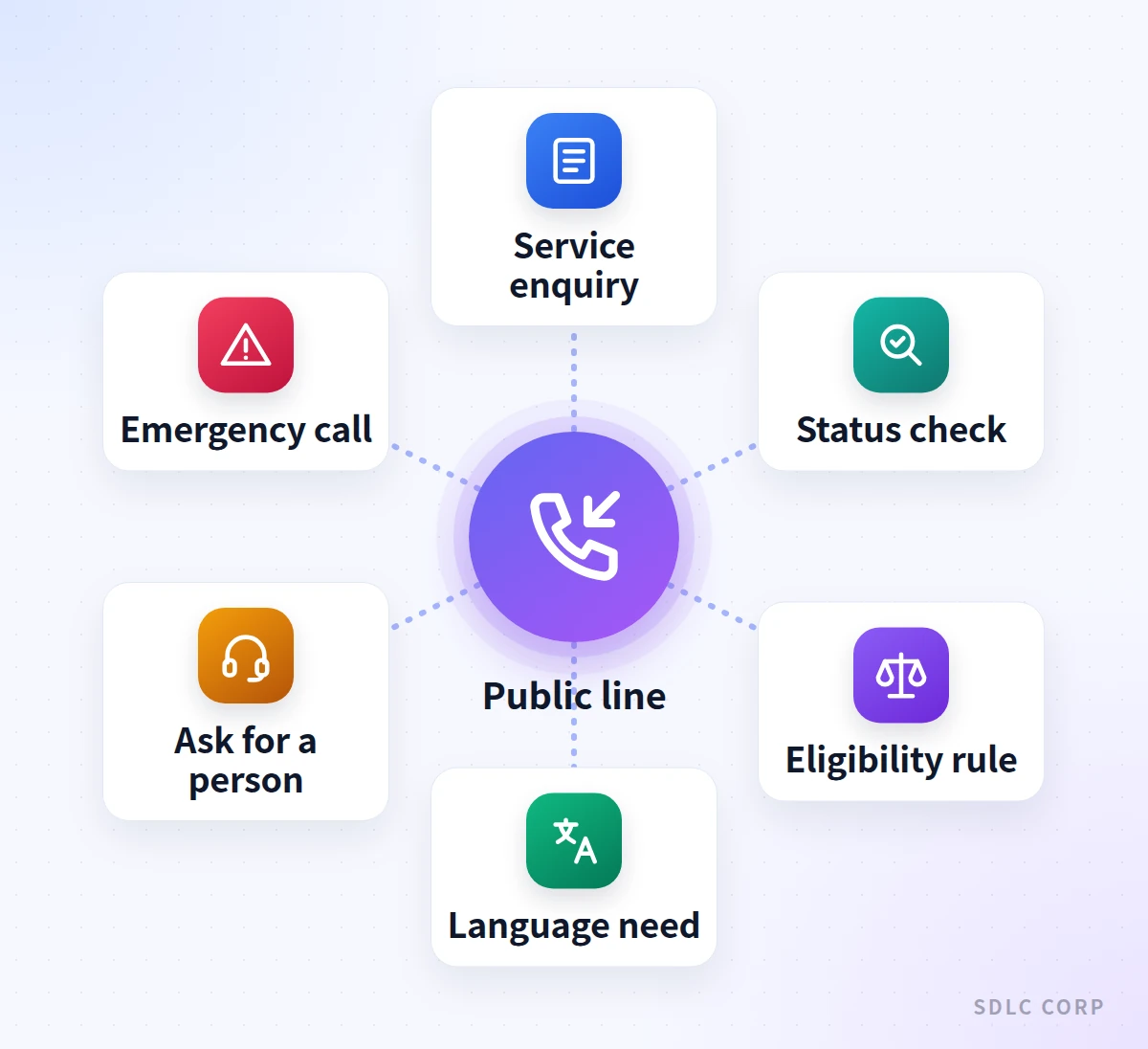
- Process and requirement questions, answered from the body's own published guidance rather than general knowledge.
- Where and when questions: opening times, locations, deadlines and what a caller should bring with them.
- Status questions about something already submitted, where a record exists and the caller can be matched to it.
- Plain redirection, for the caller who has reached the wrong service entirely and needs the right number.
Status enquiries carry a dependency the others do not. They need a record, a way to match the caller to it, and an agreed list of which stages may be stated out loud. The handling pattern is set out in answering status and progress enquiries.
Grounding matters more here than in most sectors, because public rules change on published dates and differ between areas. Pulastya answers from documents the organization provides and says when it lacks the context to answer, instead of producing a fluent guess about how a scheme works.
What happens after intake, when a call has to become a case or a ticket, is covered in turning a call into a service request. How calls reach the right team is covered in call intake and routing design.
Eligibility Questions That Must Not Become Advice
Almost every public service has a rule about who qualifies, and almost every caller wants to know whether they do. This is the most dangerous question on the line, because it sounds like a factual lookup and is actually a determination.
The agent can state the published criteria. It cannot apply them to a caller's circumstances, and it must not say anything a caller could reasonably hear as a decision, a promise, or a reason not to bother applying.
| Caller asks | Agent does | Why |
|---|---|---|
| What are the criteria? | Read out the published criteria | Same answer for everyone who asks |
| Do I qualify? | Explain that an assessment decides, then route | Applying rules to a person is a determination |
| Is it worth me applying? | Do not advise; explain how to apply | Discouragement can deny access entirely |
| Why was I refused? | Capture the request and transfer | Explaining a decision needs the record |
| What if my situation changes? | State the published rule and nothing further | Anything beyond the rule is advice |
The third row is the one worth arguing about internally. An agent that helpfully tells a caller they probably will not qualify has made the decision in practice, and made it without any of the evidence an assessor would have seen.
Stating a rule is not the same as applying it. Any wording that lets a caller conclude they have been assessed belongs to a person, and callers will hear an assessment in far less than you expect them to.
Accessibility Is an Obligation, Not a Feature
Because the caller cannot go elsewhere, accessibility on a public line is not a quality improvement to schedule for a later release. It is a condition of the service being available, and it has to be designed rather than discovered.
Language Coverage
Coverage means more than a list of supported languages. It means what the agent does for a caller whose language is not on the list, and how it behaves when somebody switches mid-sentence or speaks with an accent the recognizer handles poorly. The design space is set out in handling multiple languages and accents on calls.
Hearing and Speech Differences
A caller who cannot hear the agent clearly, cannot speak easily, or uses a relay service needs the line to work without a fluent spoken exchange. Keypad input answers part of this, and the cases where digits beat speech are set out in keypad input alongside speech.
Speech a recognizer finds difficult is not an edge case on a public line. Speech affected by illness, a stroke, medication, anxiety or age is ordinary, and an agent that fails those callers tends to fail them silently, at the moment it matters most.
Callers With No Other Channel, and the Route to a Person
Some people are on the phone because it is the only channel they have. No device, no connection, no fixed address for post, or no confidence with a form. For them the line is the service, not a support option attached to it.
- A request for a person is honored immediately, without a loop that asks the caller to try the automated route one more time.
- The route to a person is reachable without knowing the right phrase, including through silence, confusion or repeated failure to be understood.
- When nobody is available, the agent says so plainly and takes a callback rather than leaving the caller holding a queue that ends.
- A transfer arrives with the conversation attached, because repeating a difficult account is exactly what these callers find hardest.
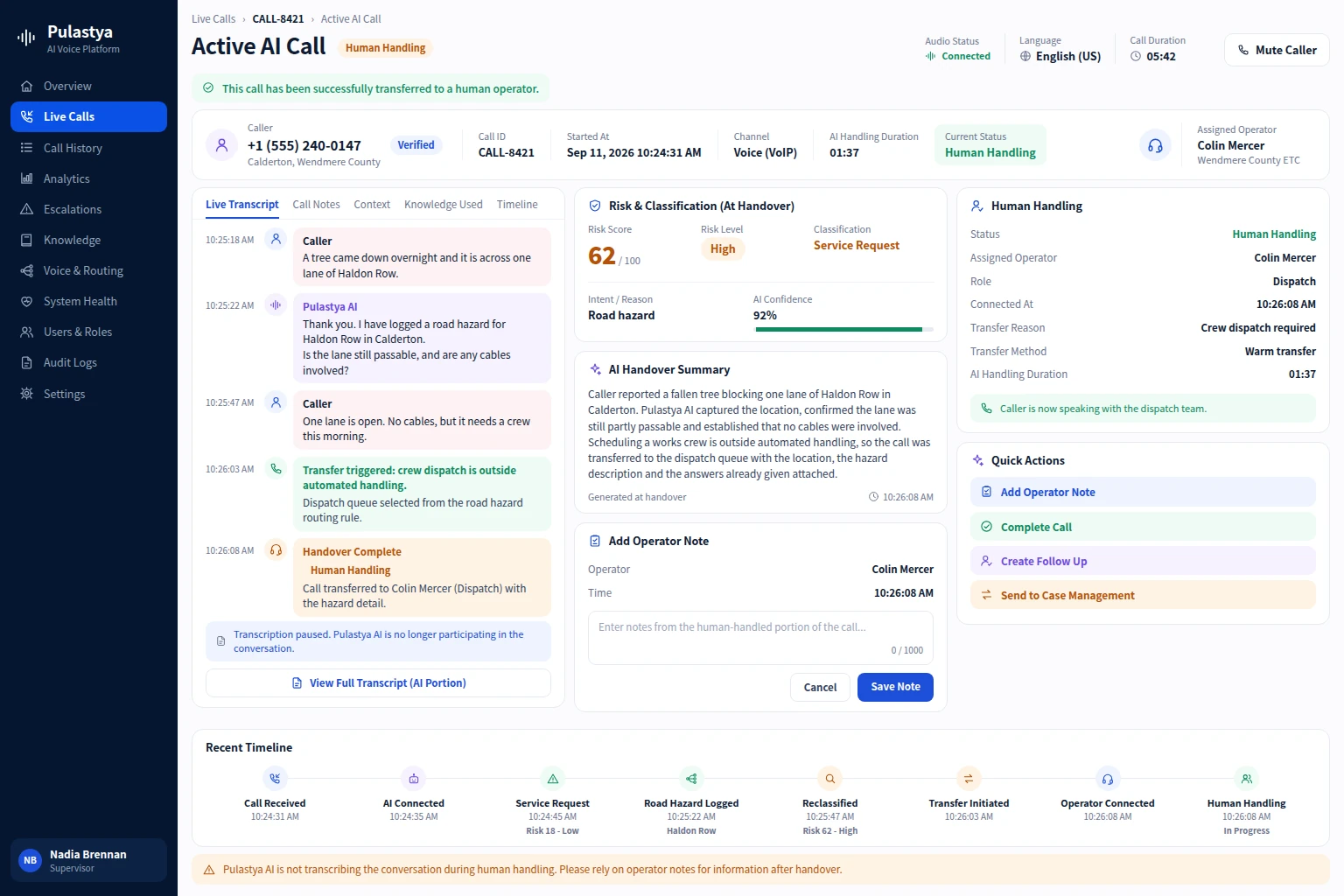
Pulastya transfers to a person with the conversation context and call summary attached, and fails over to a human line when it cannot continue. The second behavior is the one to specify hardest here, because the failure it prevents is a caller left with nothing at all.
Where the split between agent and team sits across a working day is covered in splitting call handling between an agent and a team.
When an Emergency Arrives on a Non-Emergency Line
A general enquiry line will receive calls about fire, flooding, violence, a gas smell, a collapsed structure and a person at risk. People ring the number they know, not the number that is correct for the situation.
The agent's job on those calls has exactly one part: recognize immediately that this is not the call the line is for, and move the caller to where help is. It does not assess severity, ask clarifying questions or collect details. Triage is outside scope at any confidence level.
- Say it in the greetingOpen with the standing emergency instruction, so every caller has heard it before the conversation starts.
- Set the triggers wideTreat any mention of danger, injury, fire, gas, flooding or a person at risk as an immediate exit, and accept the false positives that come with it.
- Exit without questionsGive the standing instruction and connect to a person in one move, rather than confirming or narrowing anything first.
- Never fail closedIf the transfer cannot connect, the agent still speaks the emergency instruction instead of returning the caller to a menu.
The standing instruction is written by the body itself and names the correct emergency channel for the area it serves. It belongs in approved content with a named owner and a review date, because it is the one line on the whole service that has to be right.
Calls carrying distress or risk need their own escalation and human-handoff rules, set out in handling sensitive calls.
How to Scope a Public Sector Deployment
Start with the service that generates the most repetitive calls and already has published guidance behind it. Treat the harder obligations as launch conditions rather than as improvements to schedule afterwards.
- Pick one service lineChoose high-volume, repetitive calls with guidance the body has already published and can commit to keeping current.
- Write the emergency instruction firstAgree the standing wording and the exit behavior before any other content is loaded into the agent.
- Agree the eligibility wordingDecide exactly what may be stated and what must be routed, and have the service owner sign that list.
- Prove the accessibility pathTest language coverage, keypad input and the request for a person before launch, with real callers rather than staff.
- Test with real recordingsUse recordings of the calls the line actually receives, including the callers who are hardest to understand.
Publish what the line does and does not do, in the same place the number is published. A caller who knows that the automated route cannot decide their case is far less likely to spend the call trying to make it.
A public body evaluates the same platform capabilities as anyone else. What differs is the obligations it holds them against, and the wider map of voice AI use cases by industry shows where other sectors set their own limits.
Conclusion
AI voice agents can help public bodies answer repetitive service questions, provide approved status information, and direct callers to the right team. Their value, however, depends on making public services easier to access without allowing automation to make decisions it is not authorized to make.
Begin with clearly documented enquiries, keep eligibility assessments with the appropriate staff, and design accessible alternatives and human handoff into the service from the outset. For calls involving danger or distress, use an approved emergency exit instruction rather than attempting automated triage.
Before launch, test real-world language, speech, transfer, and failure scenarios; keep published information current; and review outcomes regularly. This creates a more reliable role for AI voice agents while preserving accountability and access to human support.
Frequently Asked Questions
The repetitive ones with published answers: opening times, locations, deadlines, what a form requires, what a reference number means, and the stage a submitted request has reached. These repeat constantly, their answers are already written down, and getting one wrong is recoverable. Eligibility decisions, appeals and anything involving risk should stay with people from the start.
It can read out the published criteria. It should not apply those criteria to the caller's circumstances, because that is an assessment rather than a lookup. It should also avoid any wording that sounds like discouragement, since a caller who is told they probably will not qualify may never apply, and the decision will have been made without evidence.
The agent should recognize it at once and move the caller toward help, without asking questions, assessing severity or collecting details. Triage is not something to automate. The safe design puts the standing emergency instruction in the greeting, sets wide triggers that accept false positives, and still speaks that instruction if a transfer cannot connect.
Design for it rather than test for it afterwards. Decide what happens for a caller whose language is unsupported, offer keypad entry for people who cannot rely on speech, and make the route to a person reachable through silence or confusion rather than only through the right phrase. Then test with recordings of callers the recognizer finds hard.
Disclosure, recording notice and retention duties vary by jurisdiction, by the direction and purpose of the call, and by the legal basis a public body relies on. None of them can be assumed from practice elsewhere. Establish what applies with your own legal advisers, then write the agreed wording into the agent's opening rather than leaving it to be improvised.