
A dealership publishes one number and three different businesses answer it.
Someone wants to know whether a particular used car is still on the forecourt. Someone else wants their vehicle back by Friday. A third caller wants a part that fits a specific engine. The three want completely different things, and only one of them is a lead.
- Three departments, one greeting Sales, service and parts share a number, and the first job on that line is deciding which of the three the caller actually needs.
- Stock is a single unit A used vehicle is one physical item that sells once, so an answer about it has to come from live data rather than a document written last week.
- Checking beats guessing Saying a vehicle is still available when it sold this morning costs more than saying you will check and call straight back.
The volume arrives unevenly. Service calls cluster in the first hour and again at closing. Sales enquiries follow whenever a vehicle is advertised. Parts calls land in between, from trade customers who simply ring somebody else if nobody picks up.
What makes this line harder than most is that the answers are not general. They are about one vehicle, one job card or one part number, and every one of those can change between the morning and the afternoon.
Sorting One Number Into Three Departments
The caller does not know or care which department owns their question. They dialed the number printed on an advertisement, a service reminder or an invoice, and nothing useful can be answered until they have been sorted.
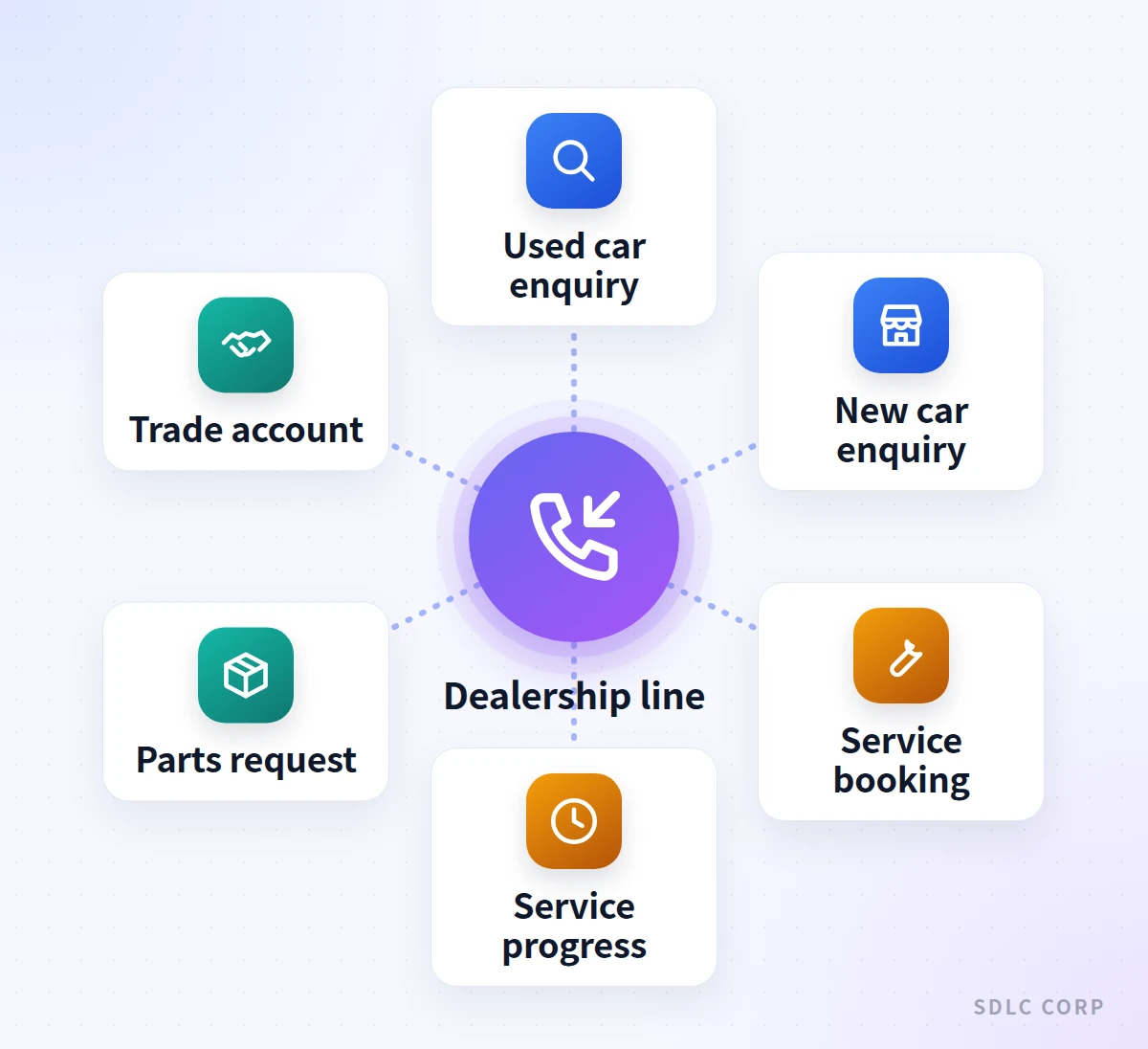
| Caller | What they are actually asking | Where the answer lives |
|---|---|---|
| Used vehicle enquiry | Is this specific car still here | The live stock record |
| New vehicle enquiry | What is available and when | Order and allocation systems |
| Service booking | When can you take my car | The workshop diary |
| Service progress | Is my car ready yet | The open job card |
| Parts request | Does this part fit my vehicle | The parts system, keyed to the vehicle |
| Trade or account call | Price and availability on account | The account record |
Those six rows sit in at least three different systems, and a caller sent to the wrong one is usually transferred twice before anybody can help. Identifying the department from the question itself, rather than from a menu the caller has to decode, removes most of that friction.
The rules that decide where each call ends up are a design exercise of their own, covered in sending each call to the team that can finish it.
A Vehicle Is One Unit, and It Sells Once
Most businesses publish information that describes a category. A dealership's most valuable answers describe a single item: this car, this mileage, this specification, this stock number. There is exactly one of it, and when it is gone it is gone.
That is what makes a purely document-based answer unsafe. A stock list exported on Monday describes Monday, and by Thursday two of its vehicles have sold and one has had its price adjusted.
The useful distinction is between facts that stay true and values that do not. Specification, equipment, recorded service history and the terms a dealership offers on every used vehicle are stable enough to live in approved content. Availability, price and whether a car is reserved are live values that belong to a system.
An agent should read the stable material from approved documents and the live values from whatever holds them, which is the split described in answering from documents versus querying a live system.
Telling a caller a vehicle has sold is an ordinary conversation. Telling them it is available, taking their details, and having a salesperson ring back to correct it is the outcome worth designing out. Where live data is not reachable, the honest answer is that somebody will check and call back within a stated time.
Sales Enquiries: Capture the Caller, Not a Commitment
An enquiry about a specific vehicle is a lead with a short shelf life. The caller is usually looking at two or three advertisements at once, and the dealer who answers first with a straight answer gets the appointment.
What an agent can finish on that call is narrow and useful: confirm what the vehicle is, find out whether the caller wants to see it, and record which car they asked about so nobody has to guess afterwards.
- The stock number or registration of the vehicle in question, so the follow-up is about the right car.
- Whether they want to view it, arrange a test drive, or are asking on behalf of somebody else.
- Whether a part exchange is involved, recorded as the caller described it and nothing more.
- When they are genuinely free, and which contact method reaches them during a working day.
Three things do not belong in that conversation. A monthly finance figure, because it depends on the caller's circumstances and on rules about how credit may be presented. A part exchange valuation, because nobody has seen the vehicle. And any suggestion that a car is being held.
How far the questioning should go before a person takes over, and which answers are worth asking for at all, is a design question in its own right, covered in designing the questions that qualify a lead.
Service Calls: Booking Is One Question, Progress Is Another
The service line carries two calls that sound alike and behave nothing alike. One is a request for a slot. The other is a request for news about a vehicle that is already in the workshop.
The booking half is a scheduling problem with dealership constraints attached: the work type decides how long the slot needs to be, some jobs need a technician with a particular qualification, and a courtesy vehicle may or may not be part of the request.
The mechanics of taking a booking during a call are covered in booking an appointment during a call.
The progress half is different, and it is the call that repeats. A customer whose car went in at eight will ring at eleven, at two and at four, because nobody told them anything in between. Each of those calls interrupts the person who could otherwise have finished the job.
An agent can answer that question where it can read the job card, and can take a callback request with the registration attached where it cannot. Either beats a ringing phone. What a progress answer should and should not contain is set out in handling calls that ask where something has got to.
Two limits matter. The agent reports what the record says; it does not turn a technician's note into a diagnosis, and it does not approve additional work. Authorizing extra spend is a conversation between a named advisor and the customer, and it usually rests on a price the agent has no business quoting.
Calling customers before the appointment, whether to confirm a booked service or to reach an owner whose work is due, is a separate outbound workflow described in reminder calls and what they change.
Parts and Trade Callers Share the Same Line
Parts calls are short, frequent and unforgiving. A trade caller wants to know whether something is in stock, what it costs on their account and whether it fits. If the phone rings out they call the next supplier, and that call is not coming back later.
Fitment is the part that cannot be improvised. Whether a component fits depends on the exact vehicle, and the reliable way to establish that is the registration or the vehicle identification number rather than the caller's description of the car.
- Capture the registration or vehicle identification number and read it back before anything else happens.
- Answer stock and price from the parts system, or take the request and commit to a callback with a time attached.
- Treat account pricing as account information: it belongs to a customer record, not to whoever happens to be on the line.
- Pass anything involving a return, a warranty claim or a credit straight to the parts desk.
Reading a registration or a long part number aloud is also where a voice system is most likely to mishear, so confirmation is not a politeness step. The techniques for capturing values like these accurately are covered in capturing spoken references and numbers reliably.
The Answers a Dealership Agent Should Refuse
Every dealership already has a list of things only a person says. Writing it down as a refusal list, before anything is configured, is what keeps an agent useful rather than risky.
- No finance illustration, monthly figure or affordability comment, whatever number the caller offers as a starting point.
- No part exchange valuation, and no opinion about what a vehicle is worth.
- No diagnosis of a fault, and no repair estimate, from a description given over the phone.
- No decision about whether a repair falls under a warranty or a goodwill contribution.
- No promise that a vehicle is reserved, held, or will still be there tomorrow.
Several of those sit on the list because they are regulated rather than merely awkward. What counts as a credit promotion or regulated advice, what must be disclosed at the start of a call, and whether a call may be recorded all depend on where the dealership operates and on the nature of the call.
Establish which apply with your own counsel, then write the agreed wording into the opening and the refusals.
Scoping a First Dealership Deployment
The temptation is to put an agent on the main number and let it sort everything out. The better first move is one department, one call type and one month, chosen so that success is obvious.
- Pick the call you are losingMost dealerships already know which one it is: the used car enquiry that rings out at six, or the parts call that goes to a competitor.
- Decide what is live and what is staticName which values must be read from a system in real time and which can sit in approved documents with an owner attached.
- Write the refusal list firstThe finance, valuation and diagnosis boundaries are the specification. Agree them before anything is configured.
- Rehearse the awkward callsTest the sold vehicle, the misheard registration, the caller who insists on a monthly figure, and the customer who has already rung three times today.
- Place the calls yourselfA test call against your own stock and your own refusal cases shows what a scripted demonstration never will.
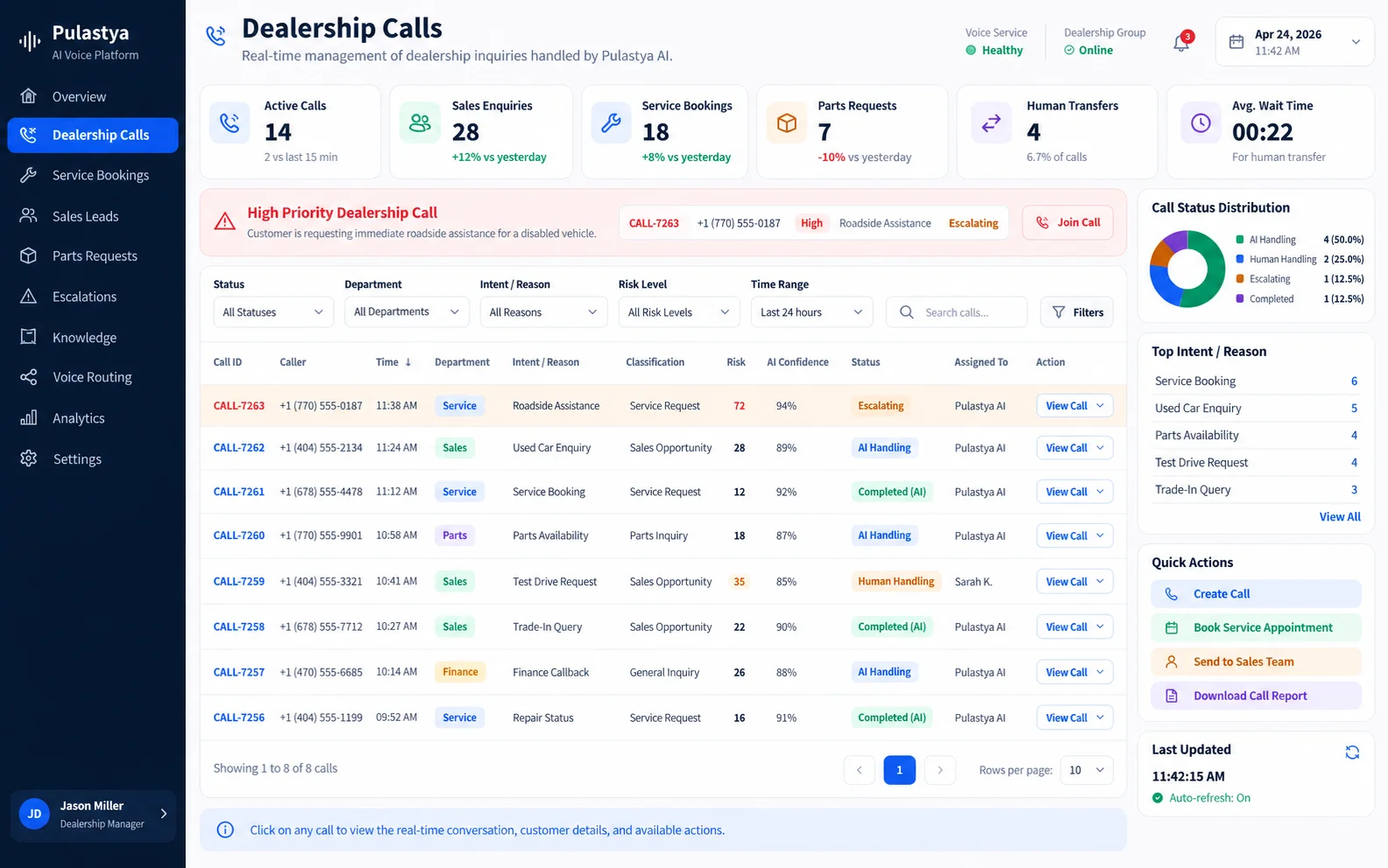
Pulastya is one example of a platform built for that shape of launch: a four-step setup aimed at business teams rather than developers, where an account is created, a number is connected, the answering documents are added, and the line is tested before it goes live.
An existing dealership number can usually be kept by pointing its webhook at the platform.
The handover is where a dealership call is won or lost. Pulastya passes a warm transfer with the conversation context and call summary attached, with failover to a human line if it cannot continue, and the detail worth testing in any platform is whether the advisor who picks up already knows which vehicle the caller asked about.
The handover mechanics themselves are set out in handing a live call to a person, and the same capabilities appear across sectors with entirely different boundaries drawn around them, which the wider map of voice AI use cases by industry lays out.
Conclusion
AI voice agents for automotive dealerships are most useful when they handle sales, service and parts calls as distinct enquiries. With access to the right live systems, an agent can direct callers, capture vehicle-specific leads, assist with service bookings and report recorded workshop progress. Vehicle availability, parts fitment and account prices must be checked against current records rather than assumed from outdated documents.
A successful rollout starts with one high-value call type, accurate data access and clear limits. Dealerships should test sold-vehicle enquiries, misheard registrations and requests for finance, valuations or repair advice before going live. When the agent cannot verify an answer or complete a task, a timely callback or warm transfer to the appropriate employee protects the customer experience and keeps commitments in human hands.
Frequently Asked Questions
Only if it can read the live stock record at the moment of the call. A document exported days earlier describes vehicles that have since sold or changed price. Where live data is not reachable, the correct behavior is to say somebody will check and call back within a stated time.
No. A monthly figure depends on the caller's circumstances and on rules governing how credit may be presented, and a part exchange value depends on a vehicle nobody has inspected. Capture the enquiry and pass it to the person who handles those conversations, keeping the lead alive without committing to a number.
It can report what the job card says where it has access to that record, and take a callback request with the registration attached where it does not. What it should not do is turn a technician's note into a diagnosis or approve extra work, both of which belong to a named advisor.
Often, yes. Parts calls are short, repetitive and highly perishable: a trade caller who gets no answer dials the next supplier immediately. The constraint is fitment, so the agent has to capture and confirm a registration or vehicle identification number before answering anything about a component.
It depends on where you operate, the direction and purpose of the call, and the rules covering the products discussed. Disclosure, recording notice and retention duties all vary and none should be assumed from general practice. Establish what applies with your own counsel, then write the wording into the agent's opening.