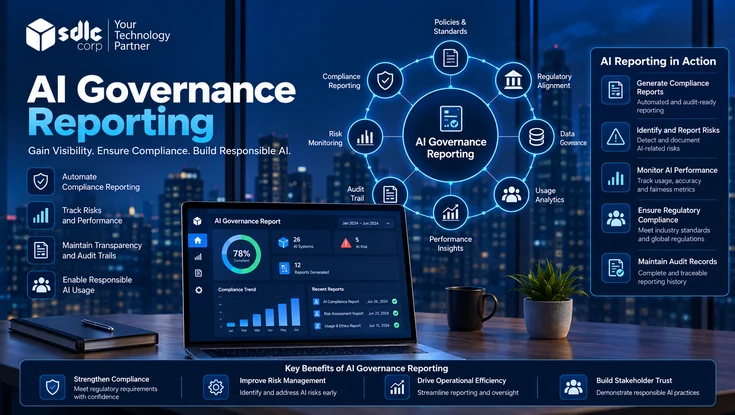
Most organizations can describe their AI policies. Far fewer can show, on demand, which AI systems are in use, which controls actually ran, what the results were, and who approved the exceptions.
AI governance reporting closes that gap. It turns assessments, logs, approvals and monitoring output into metrics and an evidence record a reviewer can follow, drawing on the same source discipline as an enterprise data governance framework and the day-to-day signal from AI usage monitoring.
What Is AI Governance Reporting?
An organization can hold hundreds of AI policies, assessments, and monitoring records and still struggle to answer one question: is our AI governance actually working? The goal is not more governance artifacts. It is governance that is measurable, traceable, and actionable inside an enterprise AI governance framework .
Governance, Compliance and Risk Reporting Compared
The same evidence can feed all three. What changes is the question being asked, the audience, and the decision being supported.
| Reporting type | Core question | Primary audience |
|---|---|---|
| Governance reporting | Are ownership, oversight, and controls in place and working? | AI, risk, compliance, leadership |
| Compliance reporting | Are applicable legal, regulatory, or contractual requirements being met? | Compliance, legal, audit |
| Risk reporting | What AI risks exist, and how are they changing? | Risk, security, executives |
The AI Governance Reporting Lifecycle
At enterprise scale, reporting should connect five activities. Each one produces the input the next one needs.

Record AI systems, owners, providers, lifecycle stages, risks, controls, and applicable requirements.
Retain assessments, approvals, testing records, monitoring results, logs, tickets, and remediation evidence.
Calculate governance performance using defined, version-controlled KPIs and KRIs.
Surface material gaps, trends, exceptions, risk exposure, control effectiveness, and business implications.
Accept, mitigate, modify, pause, or retire systems, and assign remediation where needed.
What Should an AI Governance Reporting Framework Track?
A useful reporting program starts from the evidence required to understand the AI portfolio, not from the dashboard you want at the end.
AI Inventory and Risk
System IDs, purpose, owner, provider or model, lifecycle stage, risk tier, classification rationale, impact assessment, and residual risk.
Controls and Compliance
Applicable policies, approvals, control owners, testing, required training or AI-literacy activities, and approved exceptions.
Data, Privacy and Evaluation
Data provenance, classification, privacy assessments, access controls, test plans, validation results, limitations, and independent reviews.
Monitoring, Incidents and Vendors
Alerts, incidents, severity, investigation, resolution, reporting timeliness, AI vendor risk assessment results, contractual requirements, and vendor incidents.
Exceptions and Evidence
Waivers, corrective actions, owners, deadlines, exception aging, and closure evidence.
Provenance and Lineage
Where each record originated and how it moved, which is where data lineage for AI governance does the heavy lifting.
How Major Frameworks Translate Into Reporting
Different frameworks create overlapping governance needs. The practical advantage is reuse: one governed evidence layer can serve several frameworks instead of a separate reporting system for each.
| Framework | Reporting implication | Useful evidence |
|---|---|---|
| NIST AI Risk Management Framework | Risk measurement, evaluation, monitoring, documentation | Metrics, assessments, monitoring results |
| ISO/IEC 42001 | AI management-system accountability and continual improvement | Policies, objectives, risk treatment, review records |
| EU AI Act Article 12 and Article 19 | Applicable requirements for documentation, logging, and incident reporting | Technical records, logs, incident records |
| OMB M-25-21 | Inventory and effectiveness oversight for covered federal agencies | AI use-case inventories, evaluations, monitoring |
| India AI Governance Guidelines | Accountability, risk assessment, audits, transparency, responsible AI | Assessments, audit records, governance decisions |
AI Governance Audit Evidence
Governance data describes what is being managed. Audit evidence demonstrates that a specific governance activity or control was actually performed.
| Evidence domain | What to retain |
|---|---|
| Governance | Owners, RACI assignments, committee records |
| Inventory | System ID, purpose, lifecycle stage |
| Risk | Assessments, classification rationale, risk registers |
| Policy | Approved policies, versions, training records |
| Data | Provenance, privacy assessments, access records |
| Model and system | Testing, validation, review results |
| Monitoring | Logs, alerts, performance or drift reports |
| Incidents | Investigation and response records |
| Remediation | Corrective actions and closure evidence |
| Vendor | Assessments, contracts, test results |
AI Governance Compliance Metrics: KPIs and KRIs
There is no universal regulatory KPI set. A practical enterprise model groups metrics into four categories.
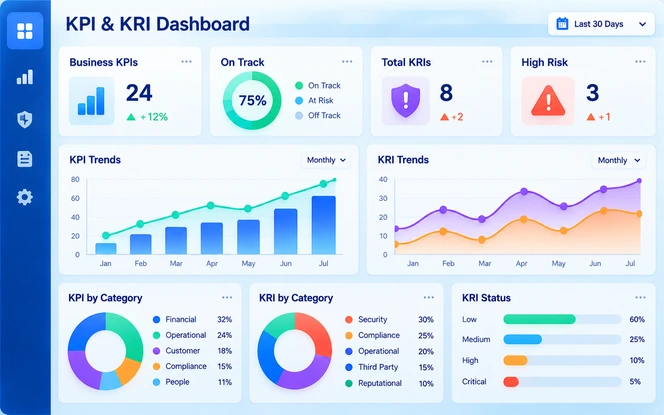
Coverage
Inventory coverage, risk-assessment coverage, and vendor-assessment coverage across the portfolio.
Compliance
Control compliance, policy violations, evidence completeness, and open exceptions.
Risk
High-risk systems, open risks by severity, critical findings, and incidents.
Effectiveness
Remediation time, control effectiveness, repeat findings, alert resolution, and incident-reporting timeliness.
Every KPI or KRI should carry an owner, definition, evidence source, reporting period, threshold, and action. Version-control the definitions too, so a reported percentage means the same thing from one cycle to the next.
Who Owns AI Governance Reporting?
Reporting breaks down when control ownership, evidence ownership, and metric ownership are treated as one responsibility. Separating them reduces the risk of a metric being produced and judged by the same party. This is the layer an AI governance operating model is meant to formalize.
| Role | Owns |
|---|---|
| Control owner | Performs or maintains the control |
| Evidence owner | Ensures required evidence is complete and current |
| Metric owner | Defines calculation logic and reporting thresholds |
| Governance or risk owner | Interprets exposure and escalates exceptions |
| Executive owner | Decides on risk, funding, acceptance, modification, pause, or remediation |
From Evidence to Executive Decision
The numbers below are illustrative and do not describe a specific client engagement. Consider an organization with 120 in-scope AI systems. 110 have completed risk assessments and 10 are missing them. Three of those 10 are potentially high-risk, and one high-risk assessment is past its remediation deadline.
The percentage is the metric. The risk context, threshold, owner, and escalation path are what turn it into a governance decision.
At Arbor Financial Group, Foresite's certified metrics and audit trail gave the risk committee enough evidence to approve client-facing dashboard reporting on its first review.
Risk-Weighted AI Governance Reporting
Raw compliance percentages can hide material risk. An organization might report that 95% of AI systems meet assessment requirements, but if the remaining 5% contains the highest-risk systems, portfolio exposure is still significant. Unapproved tools compound this, which is why shadow AI belongs in the same inventory.
How to Measure AI Governance Effectiveness
One practical view combines five signals: control results, risk outcomes, time to detect, time to remediate, and repeat-finding rate. Measure whether high-severity risks are falling, controls detect failures, findings are remediated within defined timelines, repeat findings are rising, exceptions are aging beyond thresholds, and governance reviews actually result in changes, pauses, or retirements.
AI Agent Governance Reporting
Agent governance adds a second consideration: what the system can do, not only what the model produces. Reporting should track the tools and data an agent can reach, delegated actions, human-approval points, autonomous decisions, failed or blocked actions, intervention and override rates, production errors, and response times.
Evidence Quality and Exception Aging
| Dimension | Question it answers |
|---|---|
| Completeness | Is the required evidence present? |
| Freshness | Is it current enough for the risk? |
| Provenance | Where did it originate? |
| Attribution | Can the responsible actor be identified? |
| Integrity | Can it be trusted and reproduced? |
How Often Should Organizations Report AI Governance?
There is no universal monthly or quarterly cadence. Separate legal reporting clocks from internal operating cadences, then set frequency by risk, business impact, regulatory obligation, change rate, and remediation needs.
| Cadence | What it covers |
|---|---|
| Continuous | Monitoring and alerts |
| Monthly | Operational governance review |
| Quarterly | Executive and risk review |
| Event-driven | Material incidents or significant changes |
| Annual or periodic | Management, inventory, or compliance review |
Dashboard vs. Executive Report
A governance dashboard is operational. An executive report is strategic. Dashboards help teams find alerts, gaps, overdue actions, and control-level issues. Executive reports reduce that detail into portfolio exposure, material trends, control effectiveness, business implications, and the decisions needing leadership attention. Both should draw on the same governed evidence layer.
What Should an Executive AI Governance Report Include?
An executive report should answer three questions: where is exposure increasing, which controls or obligations need attention, and what decision is required. It should cover portfolio and risk exposure, compliance posture, evidence gaps, top risks, residual risk, control effectiveness, material incidents, third-party risk, exceptions, and overdue remediation.
How to Make AI Governance Reporting Audit-Ready
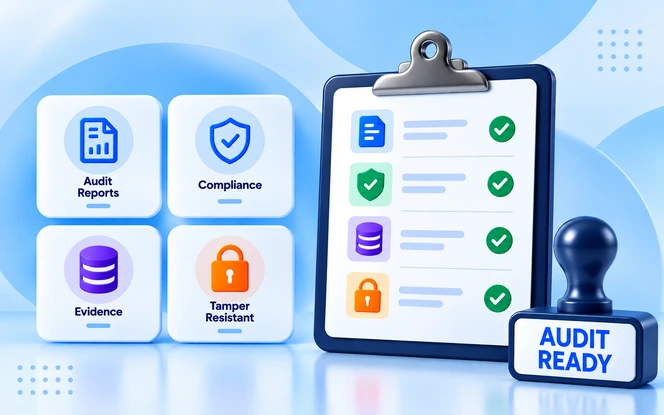
Every material metric should be reproducible by someone who did not produce it. That requires twelve attributes attached to the metric, not stored in someone's spreadsheet.
| Attribute | Attribute |
|---|---|
| Unique AI system identifier | Metric definition and version |
| System and control owner | Metric owner |
| Risk classification | Threshold and escalation rule |
| Mapped requirement | Exception or approval record |
| Evidence source and timestamp | Monitoring and remediation history |
| Retention and freshness requirement | Audit trail |
Turn AI Governance Evidence Into Executive Decisions
SDLC Corp supports AI inventory, risk classification, and lifecycle governance aligned with frameworks such as NIST AI RMF and ISO/IEC 42001. For the reporting layer, Foresite is positioned as a governed analytics platform, with certified metrics carrying named owners, version history, data lineage, freshness SLAs, audit trails, governed dashboards, and automated KPI alerts.
Making Governance Measurable
AI governance reporting is the evidence layer connecting governance activity to measurable risk, executive oversight, business decisions, and remediation. A mature program goes further than compliance percentages: it connects evidence to risk, risk to decisions, and decisions to measurable outcomes.
For enterprises building AI governance programs, often alongside a responsible AI implementation framework, the objective is not more governance artifacts. It is governance that is measurable, risk-aware, traceable, reviewable, and actionable.